I have been building things on my own for almost three years.
There is one trap I still fall into with embarrassing consistency.
I open the product to fix one small thing before showing it to people.
The button could be clearer. The onboarding could be smoother. The empty state needs better copy. While I am here, perhaps the settings page should be reorganized too.
Three days later, the small thing has become a new version.
Nobody asked for it.
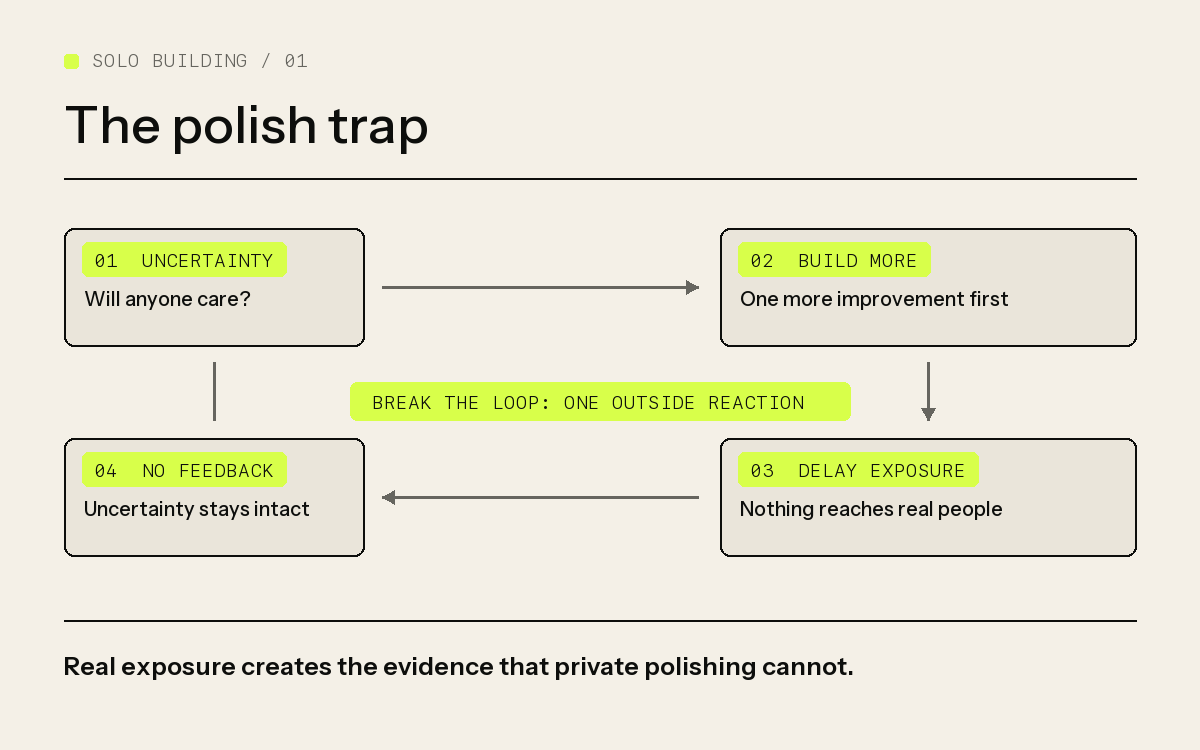
I call this the polish trap.
Polishing feels like progress because it is progress
That is what makes the trap difficult to notice.
You are not doing nothing. The product is improving. The interface looks better. A bug disappears. The work is real, and sometimes it is absolutely necessary.
But necessary product work and avoidance can wear the same clothes.
Both happen inside the product. Both create visible output. Both let you finish the day feeling responsible.
Only one brings you closer to learning whether people care.
Marketing removes the part you can control
Building is mostly a conversation between you and the thing you are making.
You decide what to change. You can keep working until the result feels better. If something is wrong, there is usually another version, another fix, another late evening.
Showing the product to people is different.
They may ignore it. Misunderstand it. Say the problem is not important. Use the product once and never return. Choose a competitor with fewer features and a worse logo.
Very disrespectful behavior, honestly.
More importantly, it is behavior you cannot control.
So the brain offers a reasonable deal: improve the product first, then market it when it is truly ready.
The problem is that “ready” moves every time you get close.
How to know when polish has become hiding
Ask where the decision came from.
Did a user get stuck? Did several people ask the same question? Did a real workflow fail? Are you fixing something that prevents the product from delivering its core value?
Good. Keep building.
Or did you notice the issue while avoiding a post you planned to publish? Are you changing the homepage again because the last message received no response? Are you adding features without knowing which user decision they should change?
That may be the trap.
Here are a few signs I have learned to recognize:
- You cannot name the evidence behind the change.
- The work delays a planned conversation, launch, or post.
- You keep saying, “Once this is done, I’ll start marketing.”
- The improvement affects edge cases before the core use case has been tested.
- You feel relief when the new task gives you a reason not to show the product today.
That last one is annoyingly accurate.
Do not ask whether the improvement is good
It probably is.
Ask whether it is the most useful thing to learn next.
A better empty state may improve the product. Five conversations may reveal that the people you built it for do not experience the problem often enough to care.
One is more comfortable. The other is more valuable.
Early-stage work is full of good ideas that are wrong for the current moment. The skill is not rejecting quality. It is choosing when quality deserves your limited time.
Give exposure a place in the schedule
“Do more marketing” is not a useful instruction.
It is too large, too vague, and very easy to move to tomorrow.
Make exposure concrete.
For example:
- publish two useful posts each week;
- reply thoughtfully to five relevant conversations;
- show the product to three people using a real workflow;
- send one small experiment before starting another feature;
- spend Friday morning only on conversations and distribution.
Choose a number small enough to repeat even when the response is underwhelming.
The goal is not to become a content machine. The goal is to stop long periods of private work from passing without contact with reality.
Make the experiment smaller than the fear
Sometimes we delay exposure because “launching” feels too big.
Then do not launch.
Share one problem observation. Send one direct message. Invite one person to try a manual version. Post one before-and-after example without announcing that you are changing the future of software.
You do not need a stage. You need a reaction.
Small exposure is still exposure. It can tell you whether the problem is familiar, whether the words make sense, and whether anyone wants the next step.
Make the test small enough that embarrassment cannot create a three-week roadmap.
Separate product debt from emotional debt
Keep two lists.
The first is product debt: bugs, confusing steps, missing requirements, and improvements connected to real usage.
The second is emotional debt: the things you want to fix because showing the current version makes you uncomfortable.
Some items will begin on the second list and later prove useful. That is fine. The point is not to shame yourself for caring about the work.
The point is to see which feeling is choosing the priority.
When I cannot tell, I use a simple rule:
Get one outside reaction before making the change.
If the reaction confirms the problem, build with confidence. If nobody notices, perhaps the polish can wait.
Set a definition of good enough before you begin
Perfection becomes especially powerful when it has no finish line.
Before changing something, decide what “done” means.
The signup flow works on mobile. A new user can understand the first step without help. The page explains one outcome clearly. The bug no longer blocks the core action.
Stop when that condition is met.
Do not let “while I am here” become a product strategy.
Care about the product. Just let reality choose where.
The answer is not to make careless things.
Quality matters. Details matter. A thoughtful product is a gift to the people using it.
But before you have enough users, you do not know which details deserve your deepest care.
That knowledge comes from the part we keep postponing: showing up, being misunderstood, hearing no, and occasionally finding the person who says, “Wait, I need this.”
Keep polishing.
Just earn the next polish with evidence.
You do not need to care less. You need something outside your head to tell you where that care belongs.