You built something difficult.
It connects five tools. It automates the annoying part. It has a dashboard that took three redesigns and one small emotional breakdown to finish.
Naturally, you put all of that on the landing page.
The integrations. The automation. The dashboard. The AI that sorts, summarizes, predicts, or does whatever we are asking AI to do this week.
Then people visit and leave.
Rude, but understandable.
They do not know why any of those features should matter to them yet.
A feature is important to you for a good reason
You know what existed before the feature.
You remember the technical mess, the edge cases, the late nights, and the tiny decisions that made it finally work. When you see “automatic client reminders,” you also see every uncomfortable email the user will never have to write again.
The user only sees three words.
They do not automatically connect the feature to a calmer Monday morning, a faster approval, fewer missed payments, or one less spreadsheet held together by fear.
You are showing them the machinery and expecting them to imagine the life it creates.
They can. They just won’t.
People are busy, your page is new, and twelve other tabs are offering something similar. If the value requires patient interpretation, most visitors will simply move on to the product that did the interpretation for them.
Features describe the product. Transitions describe the value.
A transition is the change between life before the product and life after it.
Before: client feedback arrives in four places and nobody knows which version is approved.
After: every comment, decision, and approval lives beside the work it refers to.
The feature might be “centralized feedback.” Useful information, but not the story.
The story is going from chasing decisions to knowing exactly what happens next.
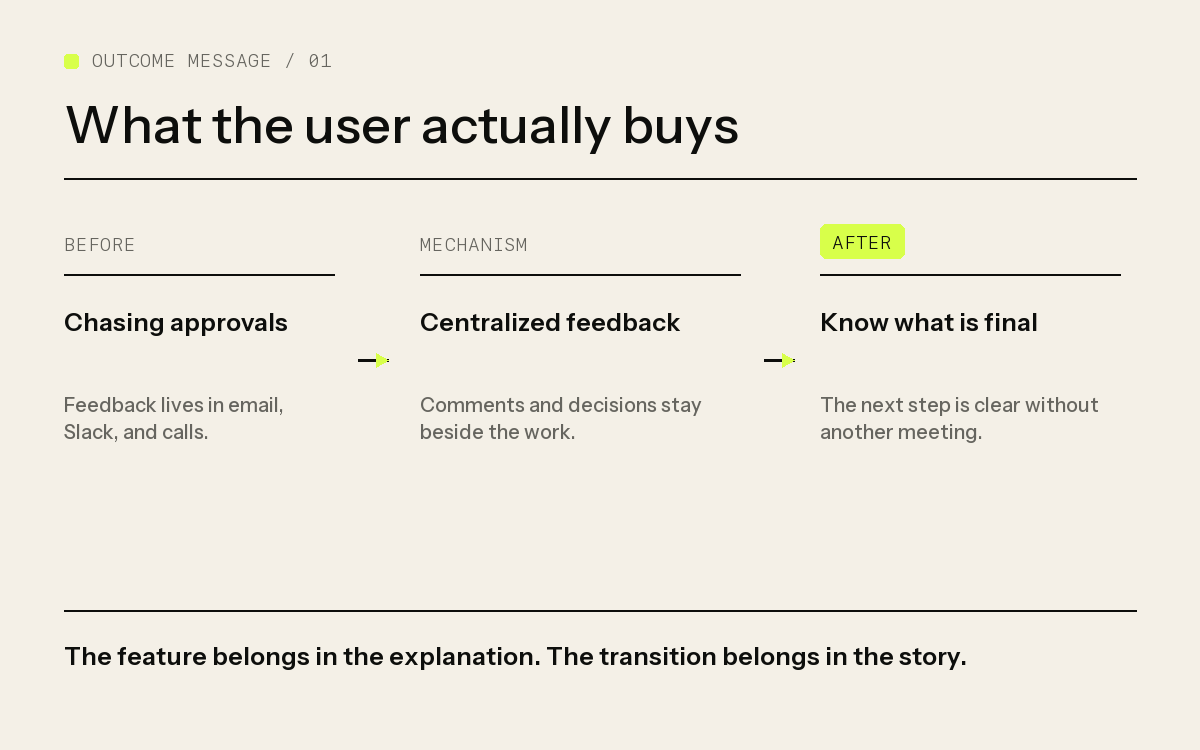
This is not wordplay. It changes how a visitor reads the product.
“Automated invoice reminders” asks them to understand a function.
“Stop writing another awkward ‘just following up’ email” lets them recognize their own life.
One explains what you built. The other explains why it belongs in their day.
Start with the life they have now
Many benefit statements fail because they jump straight to a shiny, vague future.
“Unlock your potential.”
“Work smarter.”
“Transform your workflow.”
Whose potential? Smarter at what? Transform from what into what?
A believable transition needs a clear starting point. Describe the situation the user already knows, preferably the part they are tired of.
Try answering these questions:
- What are they doing manually right now?
- What do they keep checking, copying, chasing, or remembering?
- Where does the process usually break?
- What feels awkward, risky, slow, or exhausting?
- What have they accepted as “just part of the job”?
Do not make the pain cinematic. Most useful products solve ordinary frustrations, not life-or-death emergencies.
“I spend 20 minutes every Friday combining updates from Slack” is enough. You do not need to turn it into “operational chaos is destroying the modern workplace.”
Calm down. The 20 minutes are real.
Then draw an after people can actually picture
The better life should be specific enough to imagine and modest enough to believe.
For example:
- Instead of “save time,” say “finish the weekly report before the meeting starts.”
- Instead of “improve collaboration,” say “know which feedback is approved without asking in Slack again.”
- Instead of “grow your audience,” say “know which community to post in and what first angle to try.”
- Instead of “gain visibility,” say “see which customer is blocked before they send a complaint.”
Notice that none of these promises require the user to become a new, perfect person.
They simply remove a piece of friction from a life that already exists.
That is usually more convincing than promising a revolution before breakfast.
Now bring the feature back
Features are not useless. They are evidence.
Once the user wants the transition, the feature answers an important question: how does this product make that change possible?
The order matters.
Know which client feedback is final without another status call. Collect comments directly on the design, keep every decision in one thread, and mark approved versions automatically.
The first sentence gives the outcome. The second gives the mechanism.
Without the outcome, the features are a parts list.
Without the features, the outcome may sound like a wish.
Together, they make a promise people can both want and believe.
Try the “before, after, because” exercise
Take the three features you are proudest of and complete this for each one:
Before, the user has to [current frustrating behavior]. After, they can [specific better state]. This becomes possible because the product [feature or mechanism].
For an analytics product:
Before, the founder sees traffic dropping but has no idea which change caused it. After, they can find the likely cause before opening five different dashboards. This becomes possible because the product places releases, campaigns, and traffic changes on one timeline.
Now look at your landing page.
If the “because” sentence appears first, move it down.
If you cannot write the “after” without using words such as seamless, powerful, smarter, or optimized, you probably do not understand the outcome well enough yet.
If the “before” feels invented, talk to users.
The exercise is simple. The answers may not be. That is useful information too.
One transition is enough to start
Your product may create ten different outcomes for ten different users.
Do not put all ten at the top of the page.
Choose the transition that is most urgent for the users you can reach now. Build the first message around it. Let the other use cases appear later, once the visitor understands what kind of change the product creates.
Trying to include everyone usually leaves everyone doing the same work: figuring out whether the product is relevant to them.
Do that work for them.
Show the frustrating before. Show the believable after. Then show the feature as the reason the change can happen.
Features explain how.
The transition explains why anyone should care.