You have a target user.
They are founders. Or freelancers. Or marketing teams at small companies. Maybe you got very specific and added their company size, industry, age, and favorite tools.
Good. Now answer this:
Why would any of them care about your product today?
Not eventually. Not when they finally have time to reorganize their entire life. Today.
This is the part most early-stage ICP documents leave empty. They describe a person who could use the product, then quietly assume that person is also ready to look for it.
Usually, they aren’t.
Same person. Very different urgency.
Imagine two solo founders building their first SaaS.
One has a half-finished landing page, no launch date, and is still casually trying out ideas.
The other is launching next Tuesday. They have posted about the product three times, got almost no response, and are now wondering if the product itself is the problem.
Same person on an ICP document. Only one is likely to stop and listen when you talk about distribution.
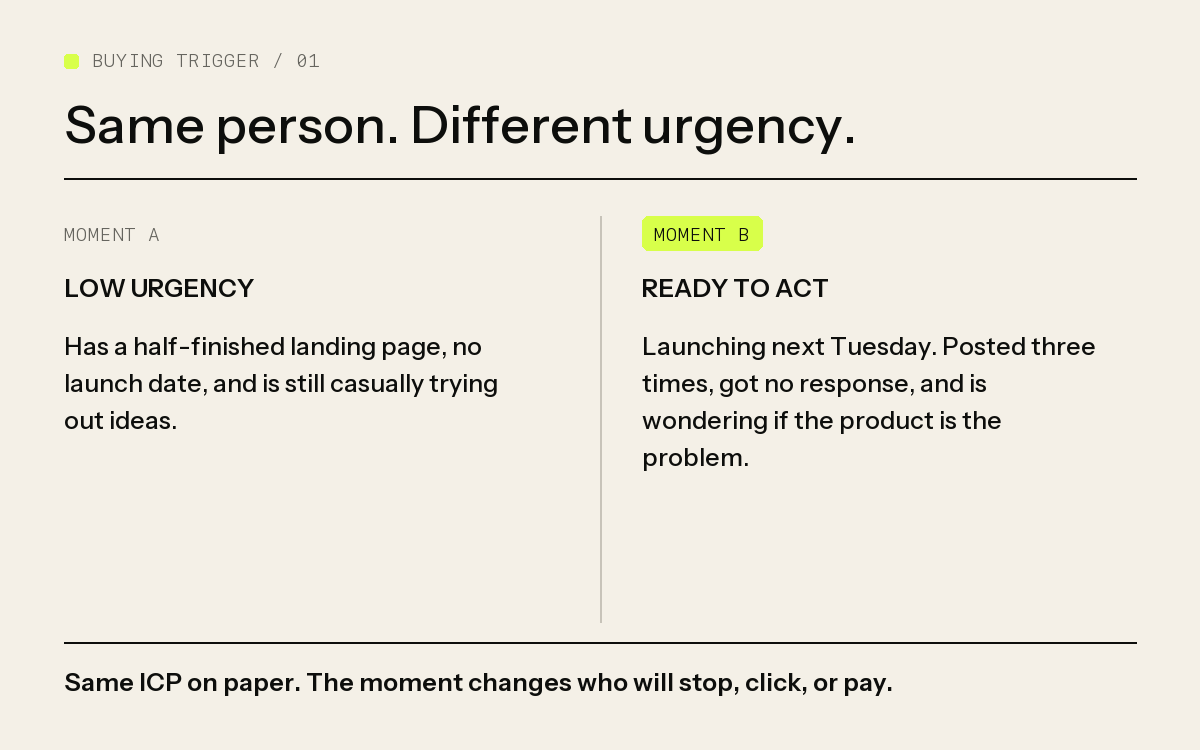
The difference is not who they are. It is what just happened to them.
That is the buying trigger.
People can live with a bad system for a surprisingly long time
We like to think a real problem naturally creates demand.
It doesn’t.
People live with annoying spreadsheets, repetitive tasks, messy processes, and mild frustration for months. They invent a workaround. They complain to a friend. Then they open the same spreadsheet again on Monday.
(I have personally kept terrible systems alive with nothing but habit and unreasonable patience.)
The problem becomes active only when something changes.
A client complains. The workload doubles. A teammate leaves. A deadline gets close. The manual process fails for the third time and someone finally thinks, “okay, I’m not doing this again.”
The problem was already there. The trigger made the old way too painful, slow, risky, or embarrassing to continue.
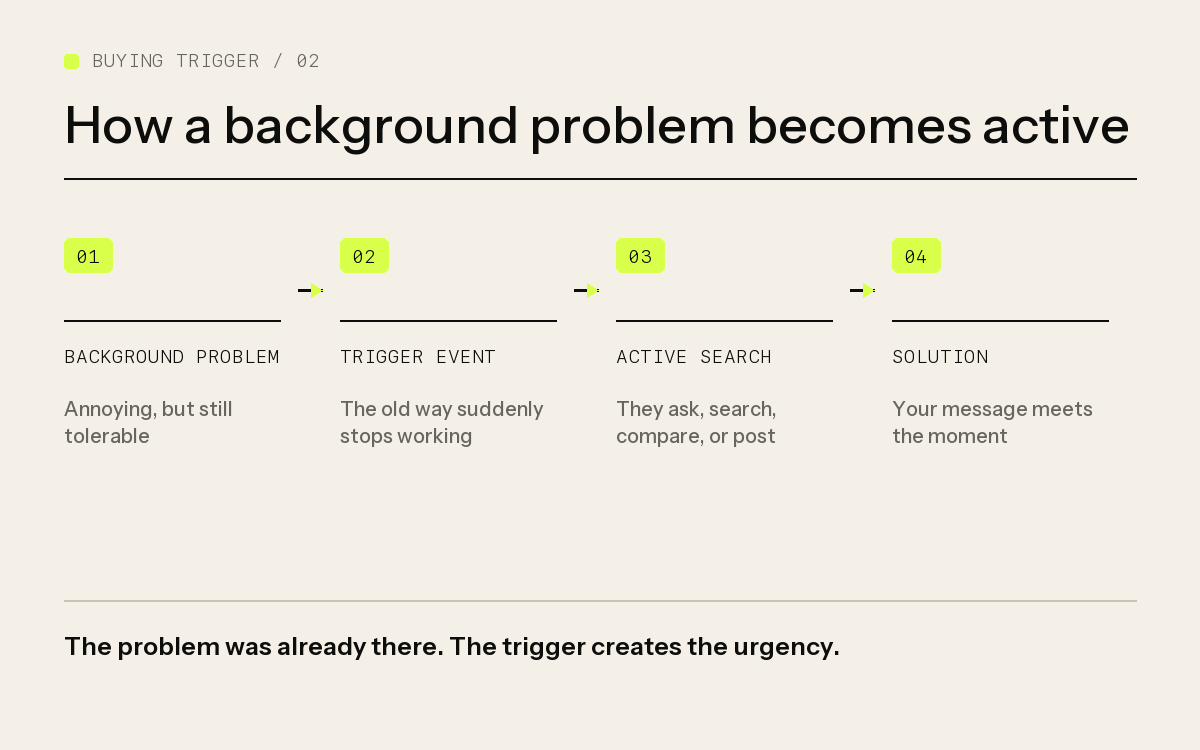
That is when people search. They ask friends. They post in communities. They compare products they ignored two months ago. Sometimes, wonderfully, they pay.
Your market tells you who. The trigger tells you when.
If you define only the person, your marketing becomes broad very quickly.
You write content for “founders.” You make a landing page for “modern teams.” You post in every startup community because technically your users could be anywhere.
Technically true. Practically useless.
Once you define the trigger, you can make much better decisions. You know what the user may type into Google, which question they might post, where they will go next, and which part of the problem your message should lead with.
Compare these:
- Project management for agencies → the moment client feedback starts getting lost across email, Slack, and calls.
- Invoice software for freelancers → the third time you have to remind a client about an overdue payment.
- Analytics for SaaS founders → you launched, people visited, and you still have no idea why nobody signed up.
- AI meeting notes → the week your calendar becomes five calls a day and you can no longer remember who promised what.
The first version names a market. The second gives you a person you can actually picture.
More importantly, it gives that person a reason to care now.
Start with what happened right before the search
You will probably not find the trigger by sitting alone and making a more detailed persona. (sadly, adding another box to the template won’t do it)
Look backward from the moment people started caring.
If you already have a few users, ask:
- What was happening when you first looked for something like this?
- Why did you look then, instead of one month earlier?
- What were you doing before?
- Was there a specific moment when the old way stopped working?
- What would have happened if you did nothing?
Ask about what actually happened. Do not ask what they “usually” do or whether your idea sounds useful. People are generous with hypothetical compliments. Their past behavior is less polite and much more helpful.
Listen for sentences like:
“We hired two more people and suddenly…”
“A client asked me to…”
“I missed one deadline and…”
“I was doing it manually until…”
That until is often where the trigger is hiding.
No users yet? The evidence is still out there.
Look at the places where people ask for recommendations. Read one-star and three-star reviews of the tools they already use. Search niche communities for phrases such as “how do you handle,” “what do you use for,” “tired of,” “alternative to,” or “there has to be a better way.”
Do not collect only the complaint. Collect what happened immediately before the person decided to say it out loud.
That detail changes everything.
“I hate invoicing” is a broad problem.
“My biggest client is 21 days late and I feel awkward asking again” is a moment you can write for.
Try this sentence
Complete this without using “everyone,” “anyone,” or “modern teams”:
We help [specific person] when [specific change or event] makes [old way] too painful, risky, or slow to continue.
For example:
We help solo founders when they have launched a working product, tried posting about it a few times, and still do not know where their first users will come from.
It does not have to become your homepage headline. Its job is to expose what you do not know yet.
Then list five possible triggers and check each one:
- Does it happen often enough?
- Does it create real urgency?
- Can I find people while or soon after it happens?
- Does my product help with the immediate next step?
The third question matters more than it looks.
A trigger may be emotionally strong but almost invisible. Another leaves clear traces: people search a phrase, join a community, install a tool, change jobs, launch a product, or complain publicly about the old solution.
For an early-stage product, a useful trigger is not only painful. It is reachable.
Find the people whose old way just stopped working
Your market tells you who could buy your product someday.
The buying trigger tells you who might be ready today.
When time, budget, and attention are painfully limited, you cannot afford to convince an entire category of people to care. Start with the smaller group already feeling the problem.
Find what just happened to them. Find where they go next. Then show up with a message that makes them think:
“Oh. This is exactly where I am.”